This project explores the demand side of conservation banking by examining who purchases biodiversity credits, where those purchases are concentrated, and how responsibility is distributed across sectors. By combining public transaction data, regional mapping, and permittee classification, the work asks broader questions about how environmental responsibility is assigned within market-based conservation systems.
Environmental policy, biodiversity markets, regional mapping, and institutional analysis
California Regional Mapping
California serves as the central case study for this project because of its long history with conservation banking, regional variation, and high levels of environmental regulation. Mapping regional activity helped me visualize how conservation banking is distributed across the state and where particular forms of market participation cluster.

To better understand patterns of market participation, I used transaction data from RIBITS and developed a classification framework for permittees based on sector, wider institutional role, and public/private status. I then paired this classification system with regional mapping in order to visualize how different buyers and industries engage with biodiversity credit markets across California.
This approach allowed me to move beyond simple transaction totals and instead ask who is participating, how often, and from what types of institutional positions. It also helped clarify how environmental mitigation responsibilities are distributed across development, infrastructure, utilities, and public actors.
Buyer Category Analysis
One major part of the project involved categorizing permittees into sector-specific and wider institutional groups. This made it possible to identify broad participation patterns and to better understand which types of actors most frequently rely on conservation banking systems.
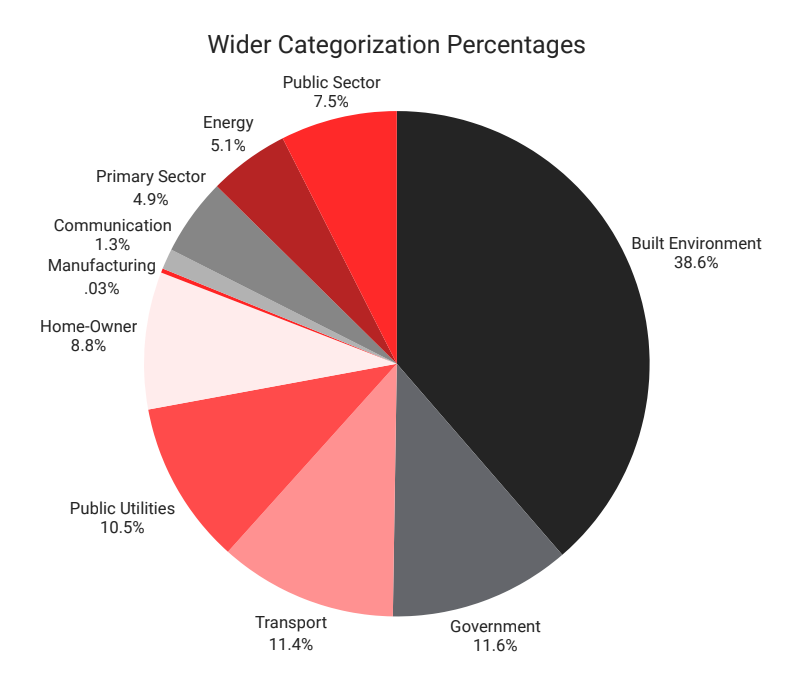
Visualization of permittee categories used to interpret biodiversity credit market participation.
Project Abstract
This abstract presents the central research question, broader context, and analytical framework behind the project.
This project reflects my broader interest in environmental policy, institutional systems, and writing that helps make complex structures more legible. It also represents the kind of work I hope to continue developing at the intersection of sustainability, policy communication, and public impact.